
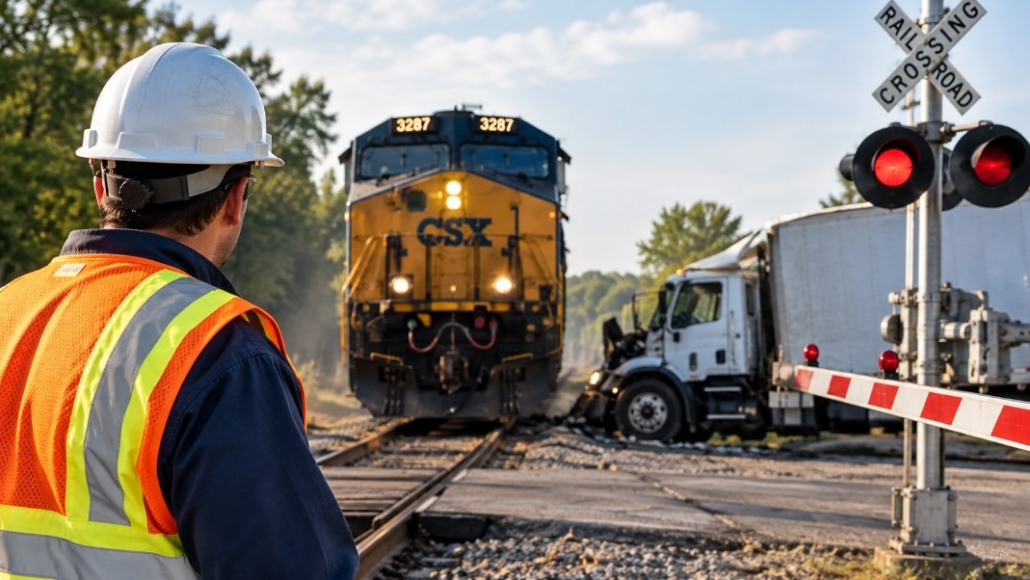
What Should Railroad Workers Know About Highway-Rail Crossing Accidents?
Operating a freight train through Alabama demands intense focus, sharp split-second decision-making, and constant vigilance. For locomotive engineers, conductors, and brakemen working the CSX lines near Birmingham’s Boyles Yard or handling Norfolk Southern routes through Jefferson County, highway-rail grade crossings represent one of the most hazardous daily operational threats. When a motor vehicle suddenly stalls, stops, or attempts to race across the tracks ahead of an oncoming locomotive, the train crew faces an immediate, unavoidable crisis.
Unlike motor vehicle collisions on state highways where drivers can stop within a few hundred feet, a loaded freight train requires up to a mile or more to come to a complete halt. When an emergency stop is initiated, the physical violence inside the locomotive cab is instantaneous. Even when a train avoids a full derailment, the extreme deceleration forces routinely cause catastrophic injuries to the crew inside.
How Do Highway-Rail Crossing Collisions Injure Train Crews?
Highway-rail crossing collisions frequently cause severe injuries to train crews through violent physical impacts and derailments. When an engineer initiates an emergency brake application to avoid a motor vehicle, sudden slack action throws workers violently around the locomotive cab, resulting in spinal trauma, head injuries, and broken bones.
Public perception often assumes that in a collision between a heavy diesel locomotive and a commercial truck, only the occupants of the automobile suffer serious harm. Railroaders know the reality is far different. Locomotive cabs lack basic safety features found in consumer vehicles, such as seatbelts, shoulder harnesses, or airbags. During a severe emergency brake application, crew members become unrestrained projectiles inside a cab constructed of hard steel and glass.
The physical mechanism of injury during a grade crossing event occurs in two distinct phases: the sudden deceleration caused by emergency braking and the physical impact. When an engineer dumps the air brakes, the sudden run-in of heavy freight cars behind the engine creates a massive wave of energy. This slack action jerks the locomotive cab forward and backward unpredictably, slamming conductors against bulkheads and control stands.
In severe collisions involving heavy commercial vehicles such as loaded logging trucks or fuel tankers common on Alabama rural routes the threat escalates to catastrophic derailments. These traumatic events routinely produce severe physical injuries, including:
- Traumatic brain injuries and severe concussions from striking steel cab fixtures
- Spinal disc herniations, fractured vertebrae, and permanent nerve damage
- Complex bone fractures in the shoulders, arms, knees, and legs
- Severe crushing injuries, internal organ damage, and traumatic amputations
Can A Railroad Be Held Liable for a Crossing Accident Under FELA?
Yes, a railroad can be held liable under the Federal Employers’ Liability Act if their negligence contributed to the crossing accident. If the carrier failed to maintain active warning signals, ignored known safety hazards, or allowed overgrown vegetation to obscure sightlines, they bear responsibility for resulting worker injuries.
Injured railroad workers do not participate in state workers’ compensation systems. Instead, their exclusive legal remedy against their employer is governed by federal law under 45 U.S.C. § 51, commonly known as the Federal Employers’ Liability Act (FELA). Under FELA, a railroad carrier owes its employees an absolute, non-delegable duty to provide a reasonably safe workplace.
To recover compensation following a highway-rail crossing collision, the injured worker must demonstrate that the railroad’s negligence played a role even the slightest part in causing the injury. Unlike standard personal injury cases where a plaintiff must prove major fault, FELA uses a relaxed causation standard. If the carrier’s negligence contributed even one percent to the accident or the severity of the crew’s injuries, the railroad is legally liable.
A carrier can be held liable under FELA for crossing hazards if the railroad engaged in any of the following negligent practices:
- Failing to properly inspect, repair, and maintain active crossing gates and warning bells
- Allowing trees or structural obstructions on railroad property to block vision
- Ignoring documented worker complaints regarding dangerous crossing configurations
- Requiring train crews to operate trains with defective horn systems or dim headlights
What Role Do Federal FRA Regulations Play in Crossing Safety?
Grade crossing safety is subject to comprehensive federal oversight. The Federal Railroad Administration (FRA) establishes legally binding standards for active grade crossing warning systems under 49 CFR Part 234. These federal regulations mandate that railroads perform routine inspections, periodic testing, and immediate repairs whenever a crossing gate, flashing light, or warning circuit experiences a failure.
In a FELA claim, proving that the railroad violated a specific federal safety regulation carries immense legal significance. Under the doctrine of negligence per se, if a carrier breaches a federal safety standard such as failing to respond to a reported signal malfunction the railroad is automatically deemed negligent as a matter of law. The injured worker is not required to prove traditional common-law negligence.
Can I Sue the Motor Vehicle Driver for My Injuries?
Yes, injured railroad workers can pursue a third-party personal injury lawsuit against the at-fault motor vehicle driver or commercial trucking company. This civil lawsuit operates separately from your federal FELA claim against the railroad, allowing you to maximize your total financial recovery for the collision.
When a highway-rail crossing accident occurs because a motorist ran through lowered gates or stopped on the tracks, that driver committed a negligent act under Alabama state law. Injured train crews have the legal right to file a third-party personal injury lawsuit against the negligent motor vehicle driver, completely separate from their FELA claim against the railroad.
This dual-claim strategy is particularly vital when collisions involve commercial motor vehicles, such as heavy freight haulers or timber trucks operating along Alabama state routes. Commercial motor carriers carry substantial liability insurance policies and can be held liable for driver fatigue, improper vehicle maintenance, or failure to obey state traffic laws.
Navigating both a FELA claim against the railroad and a third-party claim against a negligent driver requires careful legal coordination. Our legal team manages both claims simultaneously, ensuring that deadlines in federal court and Alabama state circuit courts are met while maximizing total monetary compensation from all responsible parties.
What If Overgrown Vegetation Blocked The Line Of Sight?
Railroads have a strict legal duty to maintain a reasonably safe work environment, which includes keeping crossings clear of visual obstructions. If overgrown trees or vegetation blocked the train crew’s or the motorist’s line of sight, the railroad can be found negligent for failing to mitigate the hazard.
Across rural regions of Alabama, including tracks running through Shelby, St. Clair, and Walker counties, passive grade crossings are extremely common. At these crossings, safety depends entirely on clear visibility. Motorists must be able to see approaching trains, and locomotive engineers must have an unobstructed view of the roadway approach.
Under Alabama property law and federal safety guidelines, railroads own and control a wide right-of-way bordering their tracks. The carrier has an affirmative legal duty to prune trees, clear heavy brush, and eliminate thick weeds that grow along this right-of-way. When a railroad neglects routine vegetation management, dense foliage can completely obscure an approaching train from a motorist’s view until it is too late to stop.
If overgrown vegetation on railroad property contributed to a crossing collision, the carrier cannot hide behind the motorist’s error. The failure to maintain sightlines constitutes direct employer negligence under FELA.
How Do Emergency Brake Applications Cause Worker Injuries?
When an engineer triggers emergency brakes to avoid a vehicle on the tracks, sudden deceleration causes massive slack action throughout the train. This violent jerking motion routinely throws conductors and engineers against hard steel surfaces inside the locomotive cab, causing severe trauma.
One of the most misunderstood aspects of a crossing accident is that a train crew can sustain life-altering injuries without the locomotive ever making physical contact with the motor vehicle. When an engineer spots an automobile stranded on the tracks ahead, instinct and operational rules dictate slamming the brake valve into the emergency position—a maneuver known in railroading as ‘dumping the air.’
Dumping the air releases all compressed air from the train’s braking system, applying maximum shoe pressure to every wheel on every car simultaneously. Because air pressure travels down a mile-long train at a finite speed, the front cars begin braking moments before the rear cars. The unbraked weight of thousands of tons of freight in the rear surges forward against the stopping engines, producing a violent physical phenomenon known as slack action.
This massive kinetic force slams through the draft gears and couplers, transmitting a severe shockwave directly into the lead locomotive cab. Factors that magnify the physical danger to crew members during an emergency stop include:
- Operating long, heavy trains with uneven weight distribution
- Defective or worn coupler draft gears that fail to absorb kinetic energy
- Faulty train brake systems where air fails to propagate uniformly
- Unmaintained, unsecured locomotive cab seats that shear off their mounts
What Evidence Is Required To Prove Negligence In A Crossing Accident?
Proving negligence requires securing objective evidence immediately following the collision. Essential documentation includes the locomotive’s event recorder data, inward and outward-facing camera footage, dispatch communication logs, and maintenance records verifying whether the crossing warning systems were functioning properly.
Following a highway-rail crossing accident in Alabama, the railroad carrier immediately mobilizes its claims department. While the injured train crew is being transported to a trauma facility, the railroad’s investigative team is already on scene gathering evidence designed to minimize company liability.
To protect your legal rights and build a strong FELA claim, your legal representation must move quickly to issue formal spoliation letters, legally forcing the railroad to preserve critical digital and physical evidence. Perishable evidence that must be secured includes:
- Locomotive Event Recorder Data: Digital telemetry recording exact train speed and precise timing of emergency brake application.
- Camera Footage: High-definition video showing the crossing approach, sightline obstructions, motorist actions, and cab interior movements.
- Signal Maintenance Logs: Historical records detailing prior equipment failures and repair orders for active crossing gates.
- Dispatch Audio: Recorded radio communications between the train crew and dispatchers regarding track conditions.
How Can a Birmingham FELA Attorney Help Me Recover Compensation?
An experienced FELA attorney conducts an independent investigation into the collision, secures perishable digital evidence, and navigates the complex interplay between federal railroad laws and state personal injury statutes. This legal representation ensures you secure total compensation for lost wages, medical bills, and pain and suffering.
Recovering from a severe grade crossing injury places an immense financial and emotional strain on your family. Railroad claims agents often approach injured workers shortly after an accident, offering fast, lowball settlements or attempting to coax workers into giving recorded statements that blame themselves. You should never sign documents or provide recorded statements to company adjusters without legal representation present.
At Burge & Burge, PC, our dedicated FELA attorneys have decades of specific experience fighting for railroad workers across Alabama. Located in Birmingham, we handle claims involving CSX, Norfolk Southern, and regional switching lines throughout the state. We file lawsuits in the appropriate federal venues such as the U.S. District Court for the Northern District of Alabama in Birmingham or the Southern District in Mobile to ensure your rights are aggressively enforced.
Under FELA, an injured railroader who proves carrier negligence is entitled to full, uncapped economic and non-economic damages. Recoverable damages include:
- All past, current, and future medical expenses, including surgeries and specialized medical equipment
- Full recovery of lost wages, including lost overtime and shift differentials
- Diminished future earning capacity if your neurological or physical injuries prevent a return to railroad work
- Comprehensive monetary compensation for physical pain, suffering, mental anguish, and loss of enjoyment of life
Our firm represents injured railroaders on a contingency fee basis. You pay no upfront retainer fees, out-of-pocket legal expenses, or hourly charges. We only collect a fee if we successfully win your case.
If you or a loved one suffered serious injuries in a highway-rail crossing collision anywhere in Alabama, take immediate action to protect your future. Contact Burge & Burge, PC today at 205-251-9000 to schedule a completely free, confidential legal consultation with our experienced FELA attorneys.
Frequently Asked Questions
Yes. Under applicable federal safety regulations and common-law negligence standards, railroads may have duties to inspect, test, and repair active crossing gates, flashing lights, and warning bells on their tracks. If a railroad fails to maintain required warning systems and a collision occurs, it may face liability under the Federal Employers’ Liability Act (FELA), depending on the circumstances.
If a commercial truck stalls or stops on the tracks and causes a derailment, injured train crew members may have grounds to pursue a third-party personal injury claim against the trucking company under applicable Alabama law. They may also pursue a FELA claim against the railroad if its negligence contributed to the crash. The available claims depend on the facts and evidence.
Generally, the statute of limitations for a FELA lawsuit is three years from the date the cause of action accrued. Missing the applicable deadline can bar a claim. The date the claim accrued may depend on the circumstances, so injured railroad workers should seek legal guidance promptly to protect their rights.
Yes. Depending on the evidence and the losses established, injured railroad workers may seek compensation under FELA for past and future lost earnings. This may include base pay, overtime, applicable wage increases, shift differentials, and certain employment benefits when supported by the evidence.
Yes. FELA generally uses a comparative negligence standard, meaning an injured worker’s damages may be reduced in proportion to their share of fault. However, if the railroad’s negligence contributed to the injury, the worker’s own negligence generally does not completely bar recovery under FELA. The outcome depends on the facts and applicable law.
