
Motorcycle Crash Evidence That Can Counter Disputed Fault and Rider-Blame Arguments
Motorcycle crashes can quickly become complicated when the people involved disagree about who caused the collision. Insurance companies may argue that the rider was speeding, failed to react, or made an unsafe move. These claims can make an already difficult situation even more stressful.
The right evidence can help tell a clearer story about what actually happened. Photos, traffic-camera footage, witness statements, medical records, vehicle damage, police reports, and other information can all help challenge an unfair version of events.
A motorcycle accident attorney can review this evidence and determine which details may help establish responsibility. Building the case around reliable facts can be especially important when fault is disputed or the rider is being blamed for injuries that may have been caused by another person’s actions.
Burge Law can help injured riders understand which evidence may matter when pursuing a claim and responding to disputed liability. The goal is not simply to show that a motorcycle rider was injured. The evidence should help connect the other party’s actions to the collision and resulting injuries.
When responsibility is disputed, a combination of physical evidence, witness accounts, video footage, medical documentation, and other records can provide a more complete picture of what happened. Looking at the entire sequence of events can also help challenge claims based only on assumptions about the rider.
Why Fault Is Often Disputed After A Motorcycle Crash
Motorcycle collisions can involve different versions of the same event. A driver may say the rider suddenly entered a lane, while the rider may remember having the right of way. Without supporting evidence, these competing accounts can be difficult to resolve.
Rider-blame arguments can also appear because motorcycles are smaller than passenger vehicles and may be harder for drivers to notice. That does not automatically make the rider responsible for a collision. Responsibility still depends on what each person did before and during the crash.
Evidence can help move the discussion away from assumptions and toward verifiable facts. The details may reveal vehicle positions, traffic conditions, road conditions, and the actions that led to impact.
- A police report may document the initial account of the collision.
- Witness statements may support one version of events.
- Vehicle damage may help explain the direction and force of impact.
- Road markings may show lane positions and traffic movements.
- Camera footage may capture events that happened before the collision.
Physical Evidence From The Crash Scene
The crash scene can contain important information that may disappear quickly. Vehicles are moved, debris is cleared, weather changes, and road conditions may no longer look the same later.
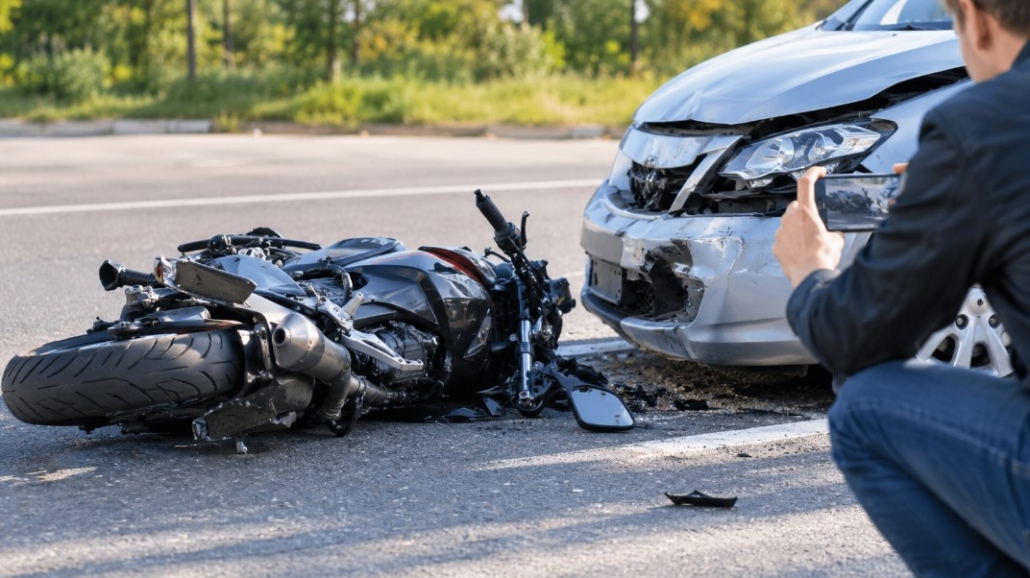
Photographs taken soon after the collision can preserve details that may become difficult to establish later. Images of the motorcycle, other vehicles, road markings, traffic signs, debris, skid marks, and surrounding area may all help provide context.
Even seemingly minor details can become important when someone claims that the rider caused the collision. For example, the location of damage on a vehicle may conflict with an argument about how the impact occurred.
- Photograph the motorcycle from multiple angles.
- Capture damage to every involved vehicle when possible.
- Photograph road signs, signals, lane markings, and intersections.
- Preserve images showing debris or visible marks on the roadway.
- Record weather and lighting conditions when they affect visibility.
How Vehicle Damage Can Help Reconstruct The Collision
Damage patterns can provide useful clues about how a collision occurred. The location, height, direction, and severity of damage may help show where vehicles came into contact.
For example, damage to the front, side, or rear of a vehicle can tell a different story about the movement of the vehicles. Damage to a motorcycle may also help demonstrate whether the bike was struck from behind, from the side, or during a turning movement.
This information should be considered alongside photographs, witness statements, traffic footage, and other evidence. Vehicle damage alone may not establish fault, but it can help test whether a particular version of the crash makes sense.
- Damage location can help identify the area of impact.
- Scrapes and dents may provide clues about vehicle movement.
- Broken parts can help document the severity of the collision.
- Repair records can preserve details about the motorcycle’s condition.
- Vehicle inspection may reveal evidence that photographs do not show.
Using Witness Statements And Traffic Footage
People who saw the collision may provide valuable information about what happened immediately before impact. A witness may have noticed a vehicle changing lanes, failing to yield, turning suddenly, or approaching the motorcycle at an unsafe speed.
Traffic cameras and nearby security cameras can be even more useful when available. Video may show the moments leading up to a crash rather than only what happened afterward.
Because many recording systems automatically overwrite older footage, identifying potential sources quickly can matter. Nearby businesses, homes, traffic intersections, parking areas, and other locations may have cameras that captured part of the incident.
- Ask witnesses what they personally observed rather than what they assumed.
- Record witness contact information as soon as reasonably possible.
- Identify nearby cameras that may have captured the collision.
- Preserve relevant footage before it is overwritten.
- Compare video evidence with the physical evidence from the scene.
For riders who need help understanding their legal options after a collision, motorcycle accident attorney after an accident resources can provide useful information about the steps that may follow a serious crash.
Medical Records Can Connect Injuries To The Collision
Medical evidence can play an important role when an insurer questions whether injuries were caused by the motorcycle crash. Prompt medical evaluation creates a record of symptoms, diagnoses, treatment, and the injuries identified after the collision.
Medical records may also help explain how an injury affects daily life. Information about physical limitations, follow-up treatment, medication, therapy, or restrictions can provide a clearer picture of the consequences of the crash.
A rider should avoid assuming that an injury is minor simply because symptoms are not severe immediately after a collision. Some injuries may become more noticeable later, particularly after the initial shock of the crash wears off.
- Seek appropriate medical attention after the collision.
- Follow the treatment plan provided by medical professionals.
- Keep records of appointments, treatment, and prescribed medication.
- Tell healthcare providers about symptoms that develop or worsen.
- Keep documentation of restrictions affecting work or everyday activities.
Challenging Arguments About Speed And Rider Behavior
Speed is one of the arguments frequently raised when fault is disputed. An insurer may suggest that the rider was traveling too quickly and therefore caused or contributed to the collision.
However, an allegation about speed does not automatically establish responsibility. The available evidence should be examined to determine what actually happened. Road conditions, traffic movement, vehicle positions, visibility, and the actions of other drivers may all be relevant.
A personal injury law firm may review the available evidence to determine whether a rider-blame argument is supported by facts or based mainly on assumptions. The circumstances surrounding the collision matter more than a simple statement that the motorcycle was involved.
- Review whether speed evidence is supported by reliable information.
- Consider traffic and roadway conditions at the time of impact.
- Examine whether another driver created the immediate danger.
- Compare witness accounts with physical evidence.
- Avoid accepting fault simply because an insurer makes an allegation.
Police Reports And Other Official Records
A police report can provide an important record of what officers observed at the scene. It may contain information about the location of vehicles, statements from people involved, road conditions, citations, and visible injuries or damage.
However, a police report is not necessarily the final word on who is legally responsible. Officers may arrive after the collision and may not have witnessed what happened. Their report can therefore be one part of a larger evidence picture.
Other records may also help establish the circumstances surrounding a collision. These can include photographs, emergency-service records, traffic-camera footage, vehicle records, and other relevant documentation.
- Obtain a copy of the available crash report.
- Review statements recorded by responding officers.
- Check whether citations were issued after the collision.
- Compare the report with photographs and witness accounts.
- Identify information that may need further clarification.
Preserving Evidence When Fault Is Contested
Evidence can become harder to obtain as time passes. Video may be deleted, witnesses may become difficult to contact, and physical conditions at the crash scene may change.
Preserving information early can therefore help protect the accuracy of a claim. Riders should keep photographs, medical documents, insurance communications, repair records, and other relevant materials in an organized place.
A Tuscaloosa motorcycle accident lawyer may also help identify evidence that could be useful when liability is disputed. This can be particularly important when the opposing party has already started developing a different version of the collision.
- Keep original photographs and videos whenever possible.
- Save important messages and insurance communications.
- Keep copies of medical and repair records.
- Write down your recollection of the collision while details are fresh.
- Avoid deleting potentially relevant information.
Common Rider-Blame Arguments And How Evidence Responds
Different claims may be used to shift responsibility toward a motorcycle rider. Some arguments may focus on speed, lane position, visibility, protective equipment, or the rider’s reaction before impact.
The important question is whether the available evidence actually supports those claims. An allegation should not be treated as fact simply because it appears in an insurance company’s investigation.
Evidence can provide a more complete picture of the circumstances. It may show that another driver failed to yield, changed lanes without adequate clearance, ignored a traffic signal, followed too closely, or otherwise contributed to the crash.
- “The rider was speeding” can be tested against available speed evidence.
- “The motorcycle appeared suddenly” can be compared with video or witness accounts.
- “The rider changed lanes” can be examined using road and vehicle evidence.
- “The injuries were unrelated” can be compared with medical records.
- “The rider caused the crash” can be tested against the complete collision sequence.
What To Do If An Insurance Company Disputes Fault
An insurance company may ask questions about the collision while investigating a claim. It may also request documents, photographs, medical records, or a statement about what happened.
Careful documentation can help prevent important details from being lost or misunderstood. Riders should keep their account factual and avoid guessing about details they cannot remember clearly.
It can also be useful to organize the evidence chronologically. Starting with what happened before the crash and then documenting the collision, emergency response, medical treatment, vehicle damage, and follow-up care can make the overall sequence easier to understand.
- Keep communication with insurers organized.
- Provide accurate information rather than speculation.
- Preserve copies of documents submitted to an insurer.
- Avoid posting detailed statements about the collision online.
- Consider legal guidance when liability remains strongly disputed.
Evidence That Can Strengthen A Disputed Claim
Strong cases are often built from multiple pieces of evidence that support the same basic story. One photograph may not prove fault, but photographs combined with witness accounts, video, vehicle damage, and medical records may create a much clearer picture.
The strongest evidence is usually specific, consistent, and connected to the events surrounding the collision. Information that directly addresses what happened before impact can be particularly helpful when fault is being challenged.
The evidence should also explain the connection between the collision and the losses that followed. Medical records, treatment documentation, work records, and other supporting documents may help establish the broader effect of the crash.
- Scene evidence can establish physical circumstances.
- Witness evidence can provide an independent account.
- Video evidence can show the sequence of events.
- Medical evidence can document injuries and treatment.
- Financial records can document accident-related losses.
Let The Evidence Tell The Story
A disputed motorcycle collision should not be reduced to assumptions about the rider. Evidence from the crash scene, vehicle damage, witnesses, video footage, medical records, police reports, and other sources can help establish what actually happened and challenge unsupported arguments about fault.
When responsibility is unclear, preserving evidence early can make it easier to respond to claims that place unfair blame on the rider. Burge Law can help injured riders evaluate the available evidence and understand their options when a motorcycle collision leads to a disputed injury claim.
If you have been injured and the other side is challenging responsibility, contact us today to discuss the circumstances of your collision and the evidence that may support your claim.
Frequently Asked Questions
