
Who Is Liable When a Motorcycle Accident Involves Road Construction in Alabama?
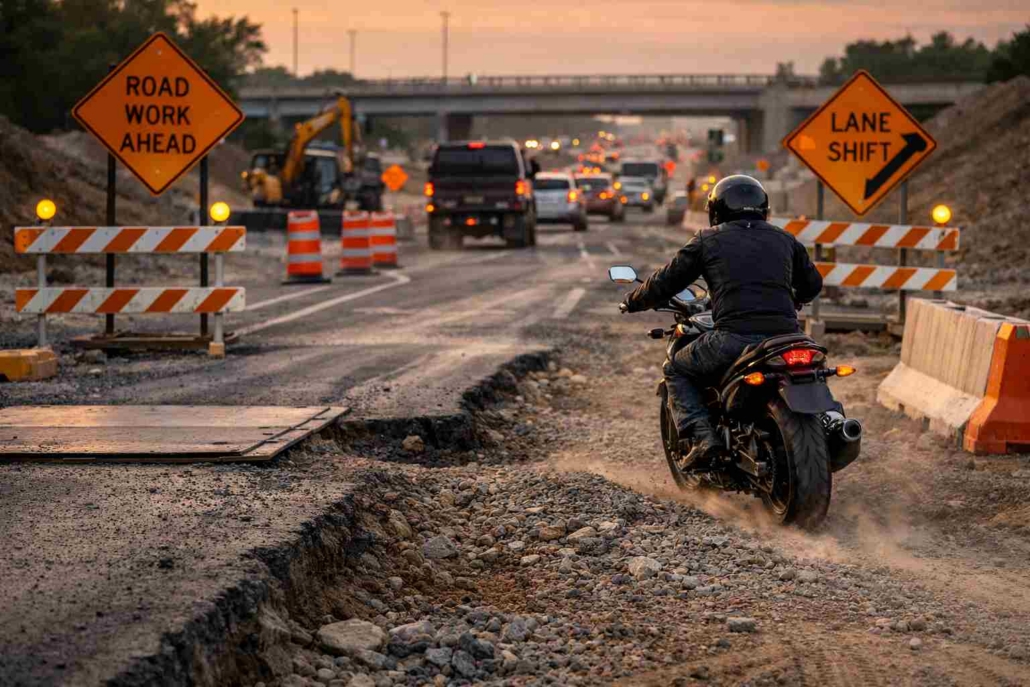
A road construction zone that is poorly signed, improperly maintained, or left in a dangerous condition is a serious hazard for any driver. For motorcyclists, it can be deadly. Loose gravel, sudden lane shifts, uneven pavement edges, and missing warning signs create conditions that rob riders of the margin for error they rely on to survive a close call. When an accident happens in one of these zones, the question of who is legally responsible is rarely simple.
Alabama’s roads are in a constant state of maintenance and expansion. From I-65 construction corridors through Jefferson County to ALDOT resurfacing projects on U.S. 280 near Shelby County, active work zones are a daily reality for Alabama motorcyclists.
Who Can Be Held Liable for a Motorcycle Accident in an Alabama Road Construction Zone?
In Alabama construction-zone motorcycle accidents, liability may fall on the construction contractor responsible for maintaining safe work zone conditions, the state or local government agency that owns the roadway, or the subcontractors and equipment manufacturers whose failures contributed to the hazard. Multiple parties are often liable simultaneously.
Identifying the right defendant is one of the most consequential decisions in a construction-zone accident case. The instinct is to assume one party is responsible, but the reality is that road construction involves a web of contractors, subcontractors, government agencies, and private companies, any of whom may have contributed to the conditions that led to your crash.
The general contractor managing the work zone typically bears the most direct responsibility. Under Alabama law and applicable federal highway safety standards, construction contractors are required to implement a Traffic Control Plan (TCP) that conforms with the Manual on Uniform Traffic Control Devices (MUTCD). [FACT-CHECK] When a contractor fails to place required warning signs, leaves loose aggregate across active travel lanes, creates a sudden drop-off between lanes and a construction surface, or removes pavement markings without replacement, that contractor may face direct liability for injuries that result.
However, the contractor is not always the only responsible party. Consider the following:
- Government Agencies: The Alabama Department of Transportation (ALDOT) or a county road department may bear responsibility if the agency’s oversight of the project was deficient, if the contract specifications themselves created the dangerous condition, or if the agency failed to act after receiving notice that the site posed a hazard.
- Subcontractors: Smaller subcontractors hired to handle specific tasks flagging, signage placement, or surface preparation can be independently liable when their specific scope of work created the dangerous condition your motorcycle encountered.
- Equipment Manufacturers: If a malfunctioning piece of construction equipment a defective road plate, a failing barricade light played a role in the crash, the manufacturer of that equipment may face a product liability claim under Alabama Code § 6-5-500 et seq.
- Third-Party Drivers: Other drivers who fail to observe reduced speed limits or merge recklessly in construction zones sometimes cause crashes that are then incorrectly attributed to road conditions. Their insurance carriers may be a source of recovery as well.
An experienced attorney will investigate all of these avenues, preserving evidence from the scene, obtaining the contractor’s TCP and safety records, and filing the appropriate claims within Alabama’s legal deadlines.
What Road Conditions in Alabama Construction Zones Most Commonly Cause Motorcycle Accidents?
The road conditions that most frequently cause motorcycle accidents in Alabama construction zones include loose gravel or aggregate left on active travel surfaces, uneven pavement transitions and edge drop-offs, absent or inadequate warning signage, sudden lane shifts without sufficient notice, and poor nighttime lighting in active work areas.
Motorcycles are uniquely vulnerable to road surface defects that most car drivers would never notice. A half-inch pavement edge that barely registers for a sedan can pitch a motorcycle tire and send a rider into oncoming traffic or a concrete barrier. This physical reality is why the legal standard for construction-zone road maintenance matters so much in motorcycle accident cases.
Loose gravel is among the most common hazards. When a contractor mills old asphalt before repaving, residual gravel and aggregate often remains on the travel surface. Striking this material at highway speed, particularly on a curve or during braking, can cause a catastrophic loss of traction. ALDOT and the responsible contractor have an obligation to sweep active lanes of these materials and to post adequate warning signs when surface conditions remain imperfect.
Uneven pavement transitions deserve particular attention. When construction advances by stages, the edge between the original road surface and a newly milled or repaved section can create a significant vertical drop sometimes several inches. For motorcycles traveling the edge of a lane or merging across lanes at the contractor’s direction, this drop-off can be catastrophic. Alabama courts have recognized that construction contractors have a duty to install appropriate bridging materials or warning signage to manage these transitions safely.
Other high-risk conditions Alabama motorcyclists encounter in work zones include:
- Faded, absent, or contradictory pavement markings in active lanes.
- Temporary lane shifts with inadequate channelizing devices or buffer zones.
- Missing or improperly placed advance warning signs required by the MUTCD.
- Steel road plates that shift under load or have edges that catch motorcycle tires.
- Inadequate lighting at night work zones near urban corridors like I-20/I-59 in Birmingham or U.S. 431 in Etowah County.
- Water accumulation due to blocked drainage in partially excavated roadways.
How Do You File a Claim Against a Government Agency for a Construction-Zone Motorcycle Accident in Alabama?
Filing a construction-zone accident claim against an Alabama government agency requires strict compliance with the Alabama Code of 1975 § 11-47-23, which mandates presenting a written claim to the governing body within six months of the injury. Failure to meet this deadline typically bars recovery entirely, regardless of how strong the underlying liability case may be.
When ALDOT, Jefferson County, Shelby County, or any other Alabama government entity is a responsible party, the path to recovery is more procedurally demanding than a standard personal injury claim. Alabama’s sovereign immunity doctrine historically shielded government entities from lawsuits, and while modern statutory law has created avenues for recovery, those avenues come with conditions that must be followed precisely.
The six-month notice requirement under Alabama Code § 11-47-23 is not a formality. Courts have repeatedly dismissed otherwise meritorious claims because the injured party often while still recovering from serious injuries did not file the required written notice with the proper government body within the deadline. The notice must generally identify the claimant, describe the nature of the injury, explain the circumstances of the accident, and specify the amount of damages claimed.
For accidents on state-maintained roads, claims are typically directed to ALDOT. For accidents on county roads, the claim goes to the county commission of the relevant jurisdiction Jefferson County Commission, Shelby County Commission, Madison County Commission, and so on. Birmingham and other municipalities handle claims against city-maintained streets through their respective city clerk offices. Determining which entity has jurisdiction over the specific road segment where your accident occurred requires careful review of road ownership records, a task your attorney should handle as quickly as possible after your crash.
The procedural distinctions do not end with notice. Government entities may raise immunities or limitations on damages not available to private contractors. An attorney who understands both the procedural requirements and the substantive standards for government liability in Alabama construction-zone cases gives you the best chance of preserving your claim and maximizing your recovery.
How Alabama’s Active Construction Corridors Create Specific Risks for Riders
Alabama maintains thousands of miles of roads in various stages of construction, resurfacing, and repair at any given time. The areas where motorcycle accidents in construction zones are most concentrated tend to be the same corridors where traffic volume and construction complexity converge.
The I-22 corridor through Jefferson and Winston Counties, the ongoing I-65 interchange improvements in the Bessemer and Hoover areas, and the U.S. 280 expansion projects between Birmingham and Childersburg represent some of the most active and hazardous stretches for motorcyclists in recent years. These high-speed, multi-lane environments compress traffic through narrowed lanes, create abrupt merges, and leave surface irregularities that can persist for months before final paving occurs.
Urban work zones present different but equally serious hazards. In Birmingham, the stretch of 1st Avenue North near the ongoing downtown utility projects, the 20th Street reconstruction near UAB’s campus, and surface work near the Jefferson County Courthouse district have created conditions where motorcyclists must navigate between construction equipment, pedestrian crossings, and redirected traffic. Riders traveling these corridors for commuting purposes heading to work in the Southside employment centers or to the University of Alabama at Birmingham face compounded risks when contractors fail to maintain safe lane surfaces.
Mobile County’s Port of Mobile approach roads and the I-10 bridge corridor construction have similarly created complex, multi-phase work zones where surface conditions change frequently and signage must be updated continuously. When those updates lag behind actual conditions, motorcyclists are placed in an untenable position: riding on surfaces they cannot have anticipated based on available warning information.
Huntsville’s growing construction landscape particularly the Highway 72 and U.S. 431 projects driven by the region’s technology and defense sector expansion has introduced new work zones into corridors that now carry significantly heavier traffic than they were originally designed for. Motorcycle commuters heading to Redstone Arsenal or the Cummings Research Park area encounter these evolving hazards regularly.
Deadlines That Can End Your Case Before It Starts
Alabama’s statute of limitations for personal injury claims is two years from the date of the accident under Alabama Code § 6-2-38. That deadline applies to claims against private contractors and other non-governmental defendants. Miss it, and Alabama courts will almost certainly dismiss your case, regardless of how serious your injuries are or how clear the contractor’s liability may be.
The deadline compresses significantly when a government entity is involved. As discussed above, the six-month notice requirement under § 11-47-23 effectively sets an earlier practical deadline for preserving a government liability claim. Since construction-zone accidents frequently involve both private contractors and government road owners, the six-month deadline is often the controlling timeline for case investigation and initial legal action.
Evidence also disappears quickly after a construction-zone accident. Contractors move on to the next phase of work, resurfacing the area and eliminating the physical conditions that caused your crash. Temporary signage is repositioned or removed. Surveillance footage from nearby businesses or ALDOT traffic cameras gets overwritten. Witness memories fade. Beginning your case investigation within days of the accident not weeks is the only way to preserve the evidence that determines who is responsible.
Mistakes That Can Undermine Your Construction-Zone Accident Claim
- Assuming only one party is responsible. Construction-zone accidents often involve multiple defendants the general contractor, a subcontractor, the government road owner, and sometimes a third-party driver. Settling with one party without a full understanding of who else bears responsibility can result in an inadequate recovery and may, depending on the settlement terms, complicate claims against the remaining parties.
- Giving a recorded statement to a contractor’s insurance adjuster. Insurance adjusters for construction companies are experienced at gathering information that limits liability. They may contact you while you are still hospitalized or in significant pain. Declining to give a recorded statement until you have legal representation is not uncooperative it is simply protecting your rights.
- Failing to document the scene. If you are physically able at the scene, photograph everything: the road surface, the location of construction equipment and signs, skid marks, your motorcycle’s position, and any visible defects in the pavement. If you are not able to do so, ask a witness, a family member, or a first responder to document conditions before the scene changes. Jefferson County Circuit Court cases have turned on photographic evidence taken in the immediate aftermath of an accident.
- Missing the six-month government notice deadline. Many injured motorcyclists focus on medical recovery in the weeks after a crash and are unaware that a clock is running on their ability to file a government liability claim. By the time they consult an attorney, months may have passed. If ALDOT or a county road department contributed to your accident, the six-month notice requirement must be addressed immediately.
Contact Burge & Burge, PC to Discuss Your Construction-Zone Motorcycle Accident
A construction-zone motorcycle accident in Alabama can produce injuries that reshape your life spinal cord damage, traumatic brain injuries, severe road rash, and orthopedic injuries requiring multiple surgeries and months of rehabilitation. The financial consequences compound quickly: medical bills from UAB Hospital or Huntsville Hospital, lost income, and long-term care needs that were not part of your plans. The contractors, insurance companies, and government agencies on the other side of your claim will have legal teams working to minimize what they pay you.
At Burge & Burge, PC, we represent injured motorcyclists throughout Alabama, and we understand both the liability framework in construction-zone cases and the procedural requirements for claims against government entities. We handle the investigation, the legal filings, and the negotiations so that you can focus on recovery. Call us today or complete our online contact form to speak with an attorney about your case.

